
Personalised Advice
A personalised advice Dynamisch Bewegen® is an approach tailored to your specific needs. The aim of the process is to restore your mobility, when you experience pain or limitations in your daily movements.
A Self-Organising Whole
Because the musculoskeletal system functions as a self-organising whole, I also consider the whole when dealing with specific local complaints. Mobilising the restrictions changes the movement behaviour of the whole, rather than just a specific detail. By thinking in terms of a dynamic system and applying this to the process of change, I work with the client on the prerequisites for coordinated movement. This allows specific movement skills to change without having to address them separately, such as walking, climbing stairs, making beds, adopting different lying positions, and so on.
Working with the Dynamisch Bewegen® movement model involves initiating a learning process. The clients have an active role by working on their mobility at home through specific exercises. To this end, I offer various ways of integrating these exercises into daily life. My approach promotes body awareness, enabling the client to perceive the body’s signals more quickly and thus prevent or reduce symptoms by applying what they have learnt.
An individual consultation lasts 90 minutes. Initially, sessions are scheduled every 4 to 5 weeks, and this gradually changes to every 6 to 8, 10 to 12 weeks, and so on. Changes to the frequency of appointments depend on the individual’s circumstances.
Costs:
Adults: €118 for 90 minutes; €85 for 60 minutes
Students: €105
Children up to 18 years old: €100
I tailor the duration and cost of a consultation to the individual situation. Shorter sessions are particularly suitable for children.
No reimbursement is available from health insurers.
Common conditions
Below you will see some examples of conditions and injuries where
Back Pain
Back problems can manifest in various ways, such as the location where the pain is felt, or whether the pain occurs only when moving or also at rest, etc.
An assessment of movement restrictions covers the entire musculoskeletal system, not just the location where the pain is felt. By restoring mobility step by step, the musculoskeletal system regains a greater scope for movement coordination, which also relieves pressure on the joints of the spine.
As Example 2 shows, lower back pain has disappeared after decades by working on the entire musculoskeletal system. In particular, the improved mobility of the neck region has led to a reduction in symptoms.


Osteoarthritis
Even if osteoarthritis is already present in the joints, it is still possible to alter the dynamics of movement. Improving mobility ensures that compressive forces can be converted more effectively into tensile forces, thereby relieving pressure on the joint. Symptoms can be significantly reduced, enabling the individual to function much better in daily life. The degenerative process is slowed down or even halted.

Scoliosis
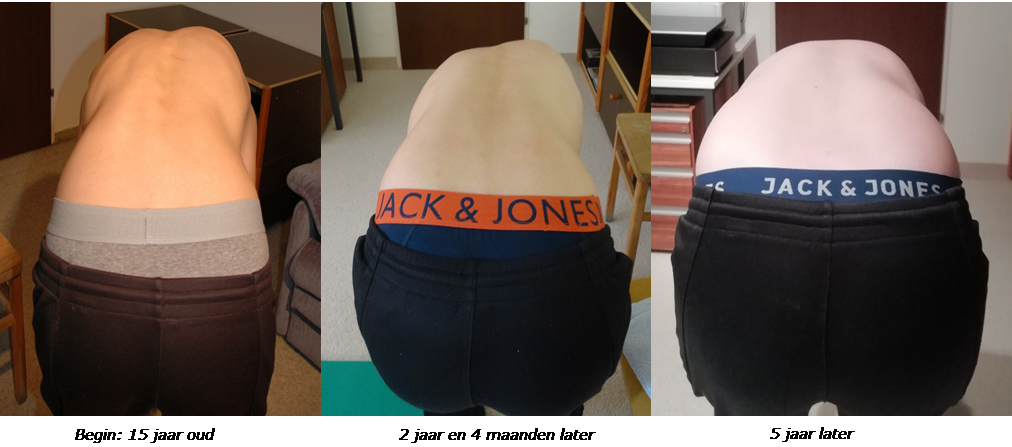
The development of scoliosis is the result of a developmental process that has not proceeded as it should. The form of scoliosis that develops during growth, known as idiopathic scoliosis, arises from a combination of factors. The interaction between factors such as restricted mobility in one or more areas, growth rate, movement patterns and range of motion determines whether scoliosis develops or not.
Because forms that arise from processes can change, the scoliotic curvature of the spine can also be altered. By gradually resolving movement restrictions, using normal development and the process of scoliosis progression as a guide, new possibilities for movement emerge. The musculoskeletal system is given the opportunity to reorganise itself. The shape of the spine changes. This process of change can be initiated at any age. The prerequisite for this is that the spine has not been surgically fused.

Recovery following accidents, sports injuries, falls and operations
The forces acting on the body during an accident leave their mark. Not just the immediately visible ones, such as wounds and fractures, or those felt as pain. When the wounds are healed and the pain has subsided, often there are still restrictions in movement.
By examining the entire musculoskeletal system and working with it, these traces become visible and can be addressed accordingly.
As a Somatic Experiencing Practitioner, I am also able to identify the trauma aspect and work with it when necessary.
Motor development, growth, injuries
Children who are still growing are more susceptible to the effects of movement limitations. The growth process itself can exacerbate and increase these limitations. This can disrupt the developmental process.
It is therefore very important to be alert to the effects of falls and accidents. Signs of restrictions include, for example, asymmetry in movement and/or body shape. By addressing these limitations, it is often possible to resolve them fairly quickly and thereby eliminate the disruptive effects.
Congenital and Acquired Brain Injury
The Dynamisch Bewegen® movement model can be applied in cases of both congenital and acquired brain injury. An adult’s range of motion is influenced by the quality of their sensorimotor development as a child. By taking into account the influence of ontogenetic development and the role of archaic reflexes in the description of motor development, it is possible to explain the emergence of so-called pathological patterns and idiopathic scoliosis.
By understanding how deformities develop, it is possible to influence the extent to which they progress, even in children and adults with severe multiple disabilities, thereby creating more scope for sensorimotor development and the maintenance of skills. With the same investment of time and resources, this approach enables better therapeutic outcomes to be achieved in both the short and long term.
