


Scoliosis
Decades of experience working with people with movement difficulties and developing the Dynamic Movement® model have given me deep insights into the natural development of motor skills and the abnormalities that can occur within it. In practice, I discovered aspects of scoliosis development that cannot be found in textbooks. This has led me, on the one hand, to approach the treatment of scoliosis from a dynamic systems perspective and, on the other hand, to identify the warning signs of scoliosis in a child and adjust the course of treatment accordingly.
The development of scoliosis is the result of a developmental process that has not proceeded as it should. The form of scoliosis that develops during growth, known as idiopathic scoliosis, arises from a combination of factors. The interaction between factors such as restricted mobility in one or more areas, growth rate, movement patterns and range of motion determines whether scoliosis develops or not.
Because forms that arise from processes can change, the scoliotic curvature of the spine can also be altered. By gradually resolving movement restrictions, using normal development and the process of scoliosis progression as a guide, new possibilities for movement emerge. The musculoskeletal system is given the opportunity to reorganise itself. The shape of the spine changes. This process of change can be initiated at any age. The prerequisite for this is that the spine has not been surgically fused.
Scoliosis from a dynamic systems perspective
An introduction to scoliosis treatment according to Dynamisch Bewegen®
This workshop provides an overview of how scoliosis develops according to the Dynamic Movement® approach and the forms it can take. Using photographic examples and skeletal models, you will gain an understanding of how to distinguish between idiopathic and traumatic scoliosis. Through various exercises, you will experience how the spine can regain its mobility. The focus is on resolving the underlying restrictions, thereby allowing new movement patterns to emerge.
A new Dynamisch Bewegen® basic course starts on 3 October 2026. This workshop is ideal for those wishing to familiarise themselves with Dynamisch Bewegen®.
Target audience: interdisciplinary (therapy, education, yoga, sport, etc.). Anyone wishing to familiarise themselves with the Dynamisch Bewegen® movement model, with a focus on scoliosis treatment, and who would like to learn more about this spinal condition.
Date: Saturday 9 May 2026, 9.00 am to 4.00 pm.
Location: Nijmegen
Cost: €170
Scoliosis Treatment Examples
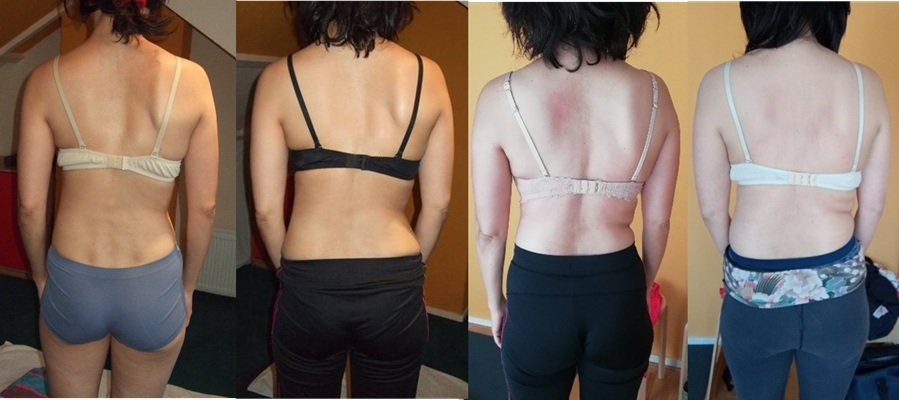
Image 1
Image 1 and 2 left to right: beginning, after 4 years and 4 months, after 7 years, after 14 years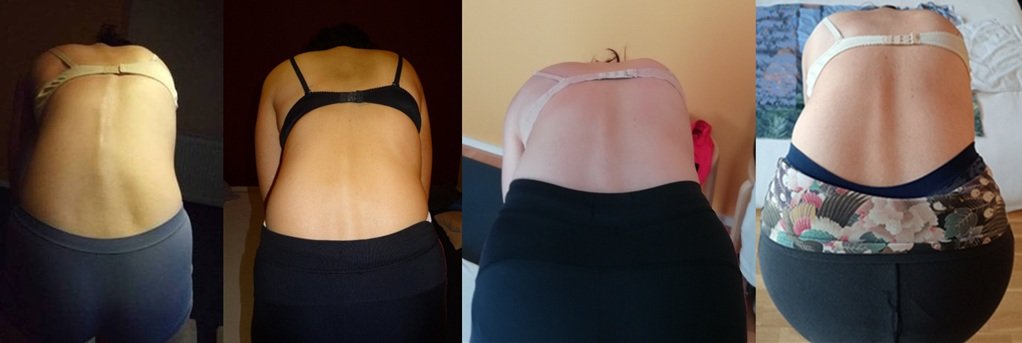 Image 2
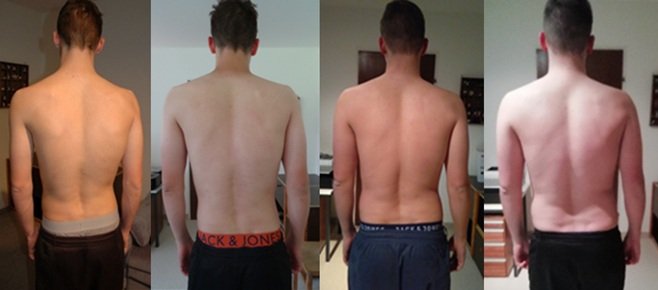 Image 3
Image 3 and 4: left to right: Beginning 15 years old, after 2 years and 4 months, after 4 years and 2 months, after 5 years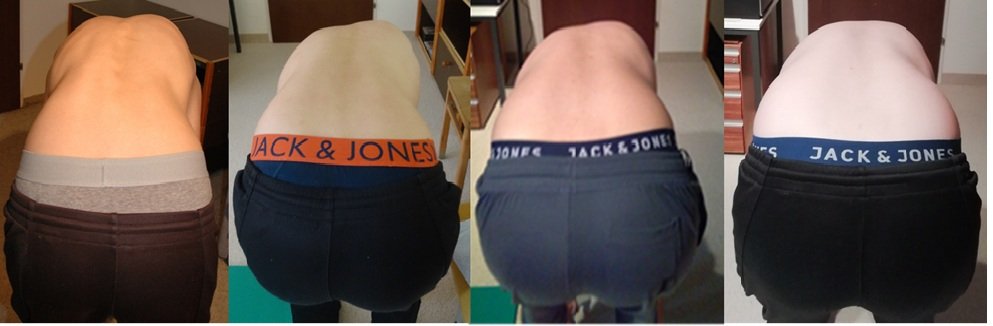 Image 4
Example of a traumatic scoliosis:
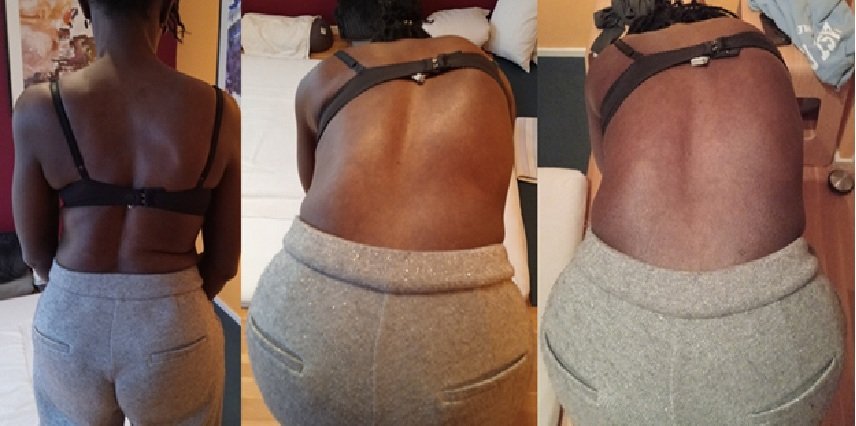
Image 5
Image 5 and 6 are examples of a traumatic scoliosis because of a movement restriction originating from a fall in her first year of life. Image 5 left and middel are at the beginning of the first session; right is at the end of the first session.
Image 6 is 11 months later.
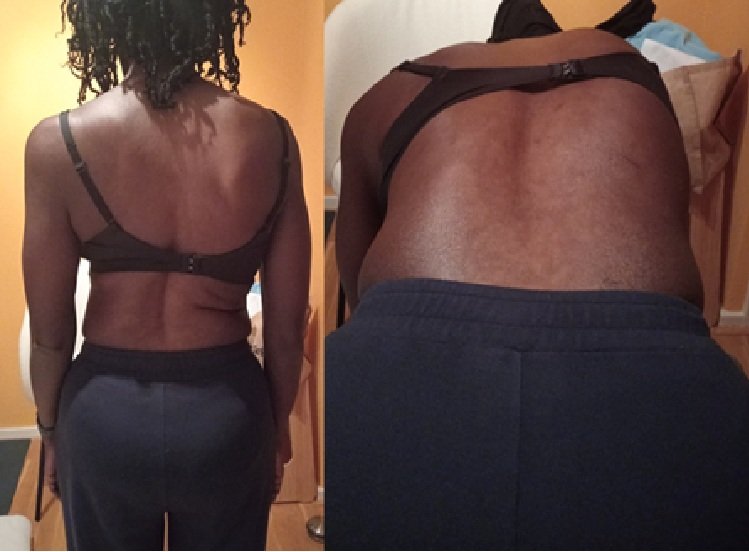
Image 6
Erfahrungen der Teilnehmer
Traude
Thank you once again for your fantastic work – once again, everyone was delighted with it and with you :-) We very much hope we’ll have the chance to work together again.
Traude
Thank you once again for your fantastic work – once again, everyone was delighted with it and with you :-) We very much hope we’ll have the chance to work together again.
Hannelén
I’ve never been this excited about a course before. You gain so much more insight and a wider range of treatment options. I think this could be valuable for everyone!
Hannelén, physiotherapist
Hannelén
I’ve never been this excited about a course before. You gain so much more insight and a wider range of treatment options. I think this could be valuable for everyone!
Hannelén, physiotherapist
Barbara
Barbara
I came across Sabine Kern in 2015 during my long quest to regain the ability to walk. Following foot surgery in 2000 on my little toe joint – a relatively straightforward procedure – the orthopaedic surgeon told me the operation had been a success, but I was still unable to walk properly. I then spent years searching for solutions and consulted various doctors, specialists and physiotherapists.
No one has really been able to identify and resolve my problem; in the end, my walking was limited to walking to my neighbour’s house down the street, a journey of about one minute.
Now, after two years of therapy with Sabine Kern, I can walk roughly four times that distance and for four times that duration, and what’s more, there’s the prospect of walking further and with better coordination. It’s quite a change after all those years of searching and making no progress when it comes to walking.
Klasien
For me, Dynamisch Bewegen is a ‘fresh start’, helping my whole body to function naturally again and showing that the human body can find its own solutions within the musculoskeletal system through dynamic movement.
Klasien
For me, Dynamisch Bewegen is a ‘fresh start’, helping my whole body to function naturally again and showing that the human body can find its own solutions within the musculoskeletal system through dynamic movement.
Lieneke Lok
Lieneke Lok
My symptoms have been present for quite a few years now. By repeatedly undergoing physiotherapy and taking painkillers, I’ve managed to keep the situation bearable, but I’ve really just been treating the symptoms. Last year, a trainee GP offered me a choice. She said: you can continue to treat the symptoms, which usually yields quick(er) results when it comes to pain relief, or you can tackle the cause. The latter takes more time because the symptoms have been present for a long time, but will ultimately yield better results. I opted for the latter and came to you for personalised exercise advice. This means that, after just two sessions, I have little to no discomfort in my face, and when I do experience discomfort, I can resolve a great deal of it myself. I’m also learning that all movements are interconnected. When my head (or neck, shoulders or back) moves in a certain (incorrect) way, it affects other parts of my body. By making changes to this, the symptoms will lessen or disappear. However, understanding makes the pain easier to bear. I think I’ve had five appointments now and I know I’m still a long way from how I could be (and perhaps will never quite get there), but I am hopeful that my pain symptoms will largely disappear, and if they do return, I will understand where they come from and be able to do something about it.
Sylvia
Sylvia
Working with Sabine is deeply rewarding in many ways. She is an inspiring woman with a great love for her profession, which she radiates and which is palpable and infectious when she is working with you. She has helped me grow immensely, both personally, as ‘her patient’, and professionally, as a physiotherapist.
For me personally, Sabine was a turning point in my way of thinking, for example, in terms of ‘accepting what is, and learning to deal with shortcomings and problems’. From the moment Sabine started working with me – five years ago – I began to think in terms of ‘possibilities and changes’. It felt like a liberation! At last, new paths opened up for me. I, as a ‘stiff as a board after a slipped disc’, was given tools by Sabine to become more dynamic and supple again. She let me, and still lets me, experience how I myself can influence the functioning of my body. What a great feeling! What you learn from Sabine and from your own body can be put into practice all day long. The result is that I can move better and more easily in every aspect of life (daily life, sport, work), which makes me feel much more energetic. I literally feel much better about myself. Highly recommended for anyone who feels they’ve ‘run out of options’.
Marijke
Marijke
If you come to Sabine with a complaint or question (of a physical nature), your life will change… from now on, you’ll be the architect of your own movement patterns!
This is an exciting and sometimes frustrating experience, but I’m absolutely delighted with it.
Thanks to Sabine’s skilled hands and clear exercise plans, I’ll never be bored again… cycling, climbing stairs, eating… to name just a few activities, offer me the chance every day to step out of my habitual patterns and move ‘differently’. My body is grateful to me for this. To put it simply: years ago, I thought I was ready for ‘a new hip’… now I feel quite differently about it.
There’s something else too: this way of working gives me a sense of vitality and contentment, and that motivates me to keep going down the path I’ve chosen (both literally and figuratively)!
